Around the year 2000, “smart working” suddenly became a thing. Not in the way we talk about it today — no Slack, no cloud dashboards, no AI assistants — but very concretely: access to your agenda, your email, your contacts. Anywhere. All the time. Devices like the Nokia 9210, Compaq iPAQ, and later BlackBerry made their appearance, and almost overnight those capabilities moved to the very top of everyone’s priority list. Apparently, playing Snake on your Nokia had lost its long‑term appeal.
There’s an anecdote from that period that always stuck with me. I can’t verify it, so let’s keep it firmly in the realm of office lore — but it’s too good not to share. A colleague once told me that at a large government institution, there was a strict replacement policy for mobile phones: devices had to last at least three years before you were eligible for a new one. Unless, of course, you lost your phone.The building had a pond in front of it. And according to the story, the bottom of that pond had never seen so many “accidental” phone arrivals as in those years, apparently, the attraction value of the newer devices was… persuasive.
There is some actual data on this as well, suggesting that between 2007-2013 the replacement cycle of phones was on a real low point at 21 to 24 months ;-)
Those early “smart” devices were functional, sometimes even impressive for their time — but they were also clunky, inconsistent, and very much tools you tolerated rather than loved. The real revolution came later, with the introduction of the iPhone. A phone without a keyboard sounded radical back then, even though touch‑based interaction had already been pioneered in the PDA world. Apple didn’t invent the idea — but it finished it. The interaction suddenly felt natural. Predictable. Calm.
Microsoft tried to respond with Windows Phone, but despite solid engineering, interacting with the UI always felt slightly “off” compared to Apple’s refinement. Add to that the reluctance of users to relearn a completely new visual language, and an ever‑growing app gap, and the ecosystem never reached escape velocity. And that combination — unfamiliar interaction plus missing mainstream apps — ultimately killed adoption.
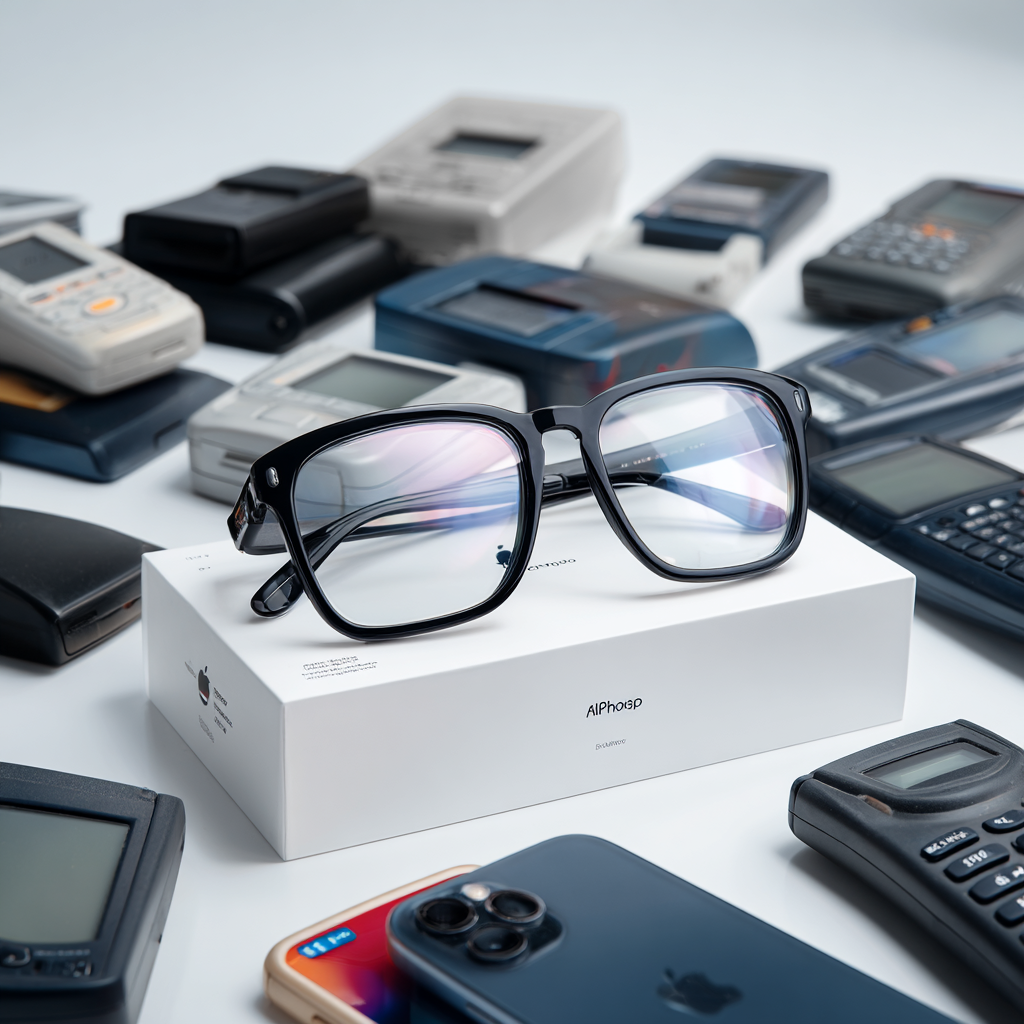
So here we are now. Eighteen years after the iPhone first appeared. Literally looking at the world through another potential interface shift: smart glasses.
Which raises an interesting question: If we compare this moment — the momentum, the experimentation, the skepticism, the excitement — to where we were in the phone story back then… where exactly are we now?
One thing that really stood out in those early years was how hyperspecialized the devices were. The Compaq iPAQ, for example, was very much an office creature. You carried it from meeting to meeting, took notes, checked your agenda, and then docked it back into its cradle at your desk, syncing it with your PC. It felt professional, almost ceremonial — but it was useless for the thing BlackBerry absolutely nailed: on‑the‑go email, tightly integrated with a phone. BlackBerry, in turn, optimized relentlessly for that single promise. Email anywhere. Keyboard-first. Always connected. It became indispensable for a certain type of role, even if it was far from a general-purpose device.
And then there was Nokia. Nokia seemed to live somewhere in between, almost undecided about which future to commit to. On the one hand, there was the Nokia 9210 — clearly a contender in the emerging ‘smart communicator’ space. On the other hand, there were absolute rockstars like the 32xx and 62xx series: dependable, corporate-approved mobile phones with battery life that many modern devices can only dream of. They were the default choice for companies at the time. Not flashy. Not experimental. Just reliable.
And I haven’t even mentioned the Palm ecosystem yet. Palm devices were arguably the most opinionated of the lot — fast, focused, and almost elegant in their simplicity. But once again: great at what they did, and conspicuously absent everywhere else.
Looking back, none of these devices were bad. In fact, many of them were excellent. They were just excellent at different things.
Which brings us to smart glasses. Because if this story feels familiar, that’s because we are seeing the same pattern unfold again — just much closer to our faces.
Today’s smart glasses landscape shows a similar kind of hyperspecialization. The promise is broad — assistance, augmentation, intelligence — but the implementations vary wildly. AI is perhaps the most binding factor of them all, even if the way it shows up differs significantly per device. In some cases, AI is the core of the experience, running directly on or close to the device itself. In others, it’s little more than a trigger: press a button on the frame, and something intelligent happens on your phone.
If we zoom out a bit, a few recognizable categories start to emerge:
- Immersive glasses
Typically non-see-through devices, often associated with VR. They replace your visual world entirely. Powerful, focused, and excellent for specific use cases — but fundamentally disconnected from everyday, ambient use (Meta Quest, HTC, Xreal, Sony VR etc.) - “See-what-I-see” glasses
See-through, always camera-enabled, sometimes with light projection onto the glass, sometimes without. Their defining feature isn’t what you see — it’s what the system can see with you. Interaction here is fundamentally camera‑mediated. Think remote assistance, live sharing, or contextual understanding of your surroundings. (Meta Ray Ban, Realwear, Vuxiz, Snap, Brilliant labs etc. - Headset-basic glasses
Glasses that look largely like regular eyewear, with Bluetooth capability in the frame and perhaps a button to trigger a simple action on a connected phone. No visual overlays, no spatial computing — just hands-free audio and microphone access. In many cases, the ‘AI’ is nothing more than a remote service: press a button, the microphone opens, a response comes back through the speakers. (Amazon Echo, Lucyd etc.) - Enhanced-vision glasses
The classic AR promise: information projected or overlaid onto your actual view of the world, in all kinds of configurations. Navigation cues, translations, prompts, annotations — sometimes subtle, sometimes ambitious. (Vuzix, Magic Leap, MS Hololens etc)
None of these categories are wrong. In fact, they are all quite good at what they are trying to do.
Which should sound familiar by now.
And for anyone who walked office floors in the early 2000s, there’s probably another image that comes to mind. Serious business people — suits, ties, very focused expressions — walking around with all their devices clipped to their belts. Phone. PDA. Pager. Sometimes two phones. Looking a bit like an office cowboy, fully equipped for whatever the day might throw at them.
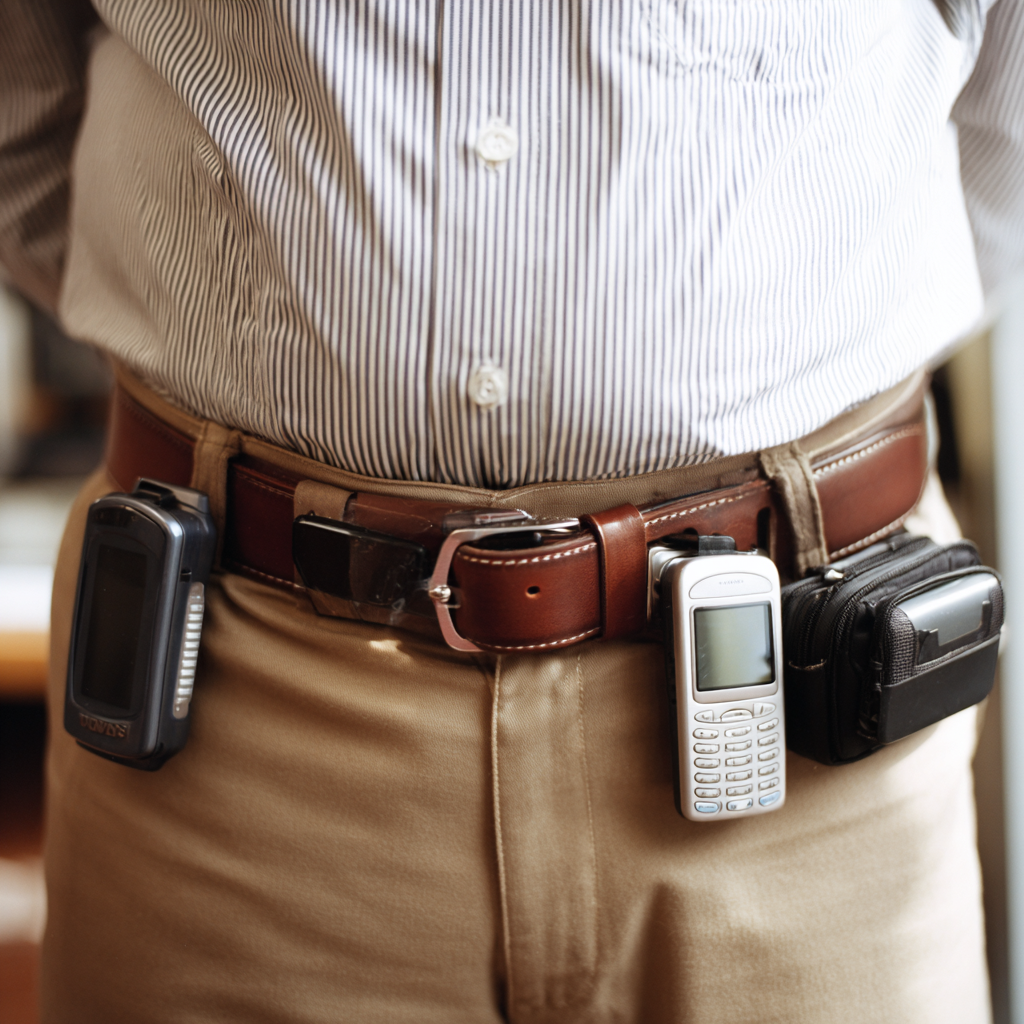
That, too, was hyperspecialization in action. And in hindsight, it explains something important: before convergence arrives, things often get a little… wild.
So ask yourself this. If smart glasses really do become mainstream — not niche, not experimental, but everyday — will you carry multiple pairs of glasses, each fitting a different use case of the moment? One for immersive focus. One for work. One for sports. One that quietly listens and nudges. Another that actually shows you things ?
So where does that leave us?
My sense is that this could go any number of ways over the coming years. But if history is any guide, the eventual winner will likely be a player that manages to collapse many of these use cases into one coherent whole. A device that can seamlessly shift between modes: immersive when you want to focus, context-driven AR when you need information, and lighter, almost invisible functions when all you want is to listen to audio, take a call, or get a subtle nudge from an assistant.
That kind of convergence poses enormous challenges for designers and engineers alike. Not just in terms of raw hardware — compute, thermals, battery life, weight — but in creating a unified interaction model that doesn’t feel compromised in every mode. Balancing all of that in something you’re willing to wear on your face, for hours at a time, is a brutally high bar.
But if and when someone manages to pull it off, the effect will be familiar.
Just like with smartphones, such a device wouldn’t merely compete with today’s specialized alternatives. It would quietly — and very quickly — render most of them irrelevant. Maybe Apple be once again the one to (re-)enter this domain with all their lessons learned..
One thing worth calling out, though, is that during a session at CES '26 on smart glasses and it's future, several speakers made a different assumption, venting the idea that there will be lasting room for many different form factors and functional variants , almost presented as a given.
That’s an understandable position — and perhaps even a necessary one. Pioneers, by definition, live in the phase where diversity thrives: where experimentation matters, where niches are valuable, and where no single design has yet earned the right to dominate. To some degree it seems to me like reassuring oneself that the path taken is actually viable. And to be clear: no successful technological shift has ever happened without those pioneers grinding away, standing up early products, testing boundaries, and absorbing the pain of being first.
Still, history suggests that once a truly coherent solution appears, the narrative tends to change. What once felt like a healthy ecosystem of variants often turns out to have been a search phase — essential, but temporary. Whether smart glasses will follow that same path, or genuinely sustain long-term diversity in form and function, remains to be seen.
I’ll be exploring this question more concretely in the coming period, with hands-on reviews of Leion’s Hey2 smart glasses and the Lucyd Lyte — both picked up at CES 2026. Keep an eye out for those reviews.